Hi,
I’M COACH KING.
A coach, educator, author and entrepreneur with a vision that everyone deserves the opportunity to fulfill their physical potential, and dedicated to making that possible for the world.


Perhaps you’ve been talking to one of the thousands of athletes, coaches or teams we’ve trained over the last four decades, or you stumbled upon one of my books, videos or online articles. You have come to the source of so many of the training concepts used globally today.
Our goal is to give you insights into what’s possible for you. Our training innovations have changed the lives of people from around the world. Now it’s your turn!
Our innovations have influenced the world of athlete preparation and coach education for over 30 years. Here are some examples of these innovations, including Speed of Movement, Lines of Movement, Muscle Balance, Control and Stability, Muscle Activation and Reverse Periodisation. Read more about these below!
I was searching for a way to communicate the varied speeds of movement in strength training to the athlete. The result was a three-digit method (e.g. 311), where the first number was the lowering (in seconds), the middle number the pause (in seconds) and the third the lift in seconds. After testing this method for a number of years I published it in the late 1980s.
After becoming concerned with the muscle imbalances evident in strength athletes I was looking for a way to categorize exercise to avoid these imbalances . The result was what I called the ‘Lines of Movement’ concept, where I divided the body up in to family trees, and then in muscle groups or planes of movement such as hip and quad dominant, vertical pull and push; and horizontal pull and push.
The Lines of Movement concept allows anyone to develop training programs that potentially reduce the incidence and severity of injuries e.g. “For every upper body pushing movement, there would be an upper body pulling movement. For every vertical pushing movement there would be a vertical pulling movement. For every hip dominant exercise there would be a quad dominant exercise. And so on.”
Recognising something missing in strength program design and periodisation, I developed a range of exercises, methods and strength quality I called ‘Control & Stability’. These methods were “characterized by high reps, nil to minimal external load, and shorter to nil rest periods, controlled eccentric movements combined with controlled concentric movements, with the possible addition of some static isometric holds.”
To insure the improvement of Control & Stability in all athletes I introduced the concept of using a few ‘control drills’ at the start of every strength training session. These were intended to “increase their contribution to selective muscle activation, which has both a performance enhancement and an injury prevention role.” Typical protocols recommend were 10-20 reps per exercise with controlled speeds of movement.
Convinced that the dominant paradigm of the ‘aerobic base’ was flawed and sub-optimal I developed alternative approaches, based on much lower energy system training volumes in the General Prep Phase (off-season). I concluded that starting with high intensity and lower volume and slowing raising the volume with the intent of holding the intensity was effective and called this ‘Reverse Periodization’.
We will also sign you up for our ‘Between Sets’ Newsletter to receive our most up to date info.
Because every one of you is different and unique we want you to learn how to think for yourself, not simply follow the masses or dominant trends. Get guidance on how to make better training decisions with the hundreds of episodes at our video library KSITV.
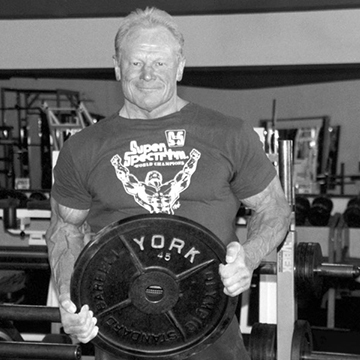
amidst the hard-working and smart-working core of bodybuilders who want a more complete understanding of the “why” and “how come” beneath the surface of muscle building.
Dave Draper ‘The Blond Bomber’
American bodybuilder (1965 IFBB Mr. America, 1996 IFBB Mr. Universe, and 1970 IFBB Mr. World titles), actor and author
your books are the best, I highly recommend them to everybody, every trainer, lifter or athlete should have the collection.
Eric Serrano, MD
World famous nutrition and supplementation expert

In our opinion, the science of getting bigger and stronger can be equally divided into two times periods: Before King and After King. He’s that good.
TC Louma
Editor-in-Chief T-Nation
Dear Ian, loved your books. Keep up the good work. All the best, Charlie
Out of all the incredible coaches that contribute to T-mag, the way I train has been influenced more by Ian King than any other. Sure, I pick up a thing or two from every coach, but Ian has really influenced the way I design training programs for myself and others.

While we are on the training topic, my Australian friend Ian King (one of the world’s top trainers) has published his 4th “Seriously Get Buffed” training book. The complete series is phenomenal. Anyone who is looking for more info on training, nutrition and physique improvement should have King’s work.

Ian King is the antithesis of what you may think a strength coach would be…Ian is not a pundit of any particular method or secret strategy obtained from scientific calculations…To so many of the currently popular exercise “authorities,” the line of thinking is, “It worked for me, so it’ll work for you.” More often than not, it seems as if good portions of these “principles” are little more than a marketable gimmick. You’ll get no such spin doctoring from Ian King. No shortcuts here…

Sign up to receive the KSI ‘Between Sets’ Newsletter.